
Social Media Marketing Best Practices
Chapter 4
"This is not a new marketing channel. This is not a new technology. This is not a movement... It’s more. And yet, it’s so easily misappropriated and malformed and co-opted that it could just as easily be brushed aside. This isn’t the battle of who “gets it” and who doesn’t. It’s the battle to shape these new pathways with the help of these new tools and methods..." - Chris Brogan
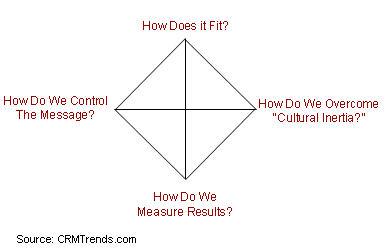
It is a platform where people congregate and connect. It used to be, "How do I participate?" Now it is so much more. It used to be about conversations. It is now about real interactions between real people. So don't trust this to someone inexperienced and just out of school. With this section, we hope to provide some thought starters for you as you develop and augment your social media roadmap - answering the questions:
 |
Social Media
The consumer of today has taken a "digital first" posture. When the consumer is looking for a plumber or a restaurant to eat at, where do they go first? They go digital first. As such, as a marketer, you need a "digital first" posture as well. Social is about engagement - so your content has to be findable and shareable. The ultimate destination of traffic generated from social media marketing efforts is to the content on your web site. So before you begin with new distractions, make sure you're leading with a great site. Once you have that, make sure there is a re-examination of the user's multi channel experience i.e. is there a consistency of information and experience across all channels? Once you have those basics covered, then you're ready for social media marketing best practices.
In developing your social media roadmap, don't think of this as a platform for marketing, but a platform for publishing. Tell stories - real stories. Telling stories evokes an emotional reaction - compelling stories engages people. Ask the question: "What are you doing to create a real interaction with a real human being?" After all, we live in a world where people are trying to communicate with us.
How the social network ecosystem functions is an important consideration as you develop your social media marketing strategy. The "1% rule" states that in a community of 100 members, one person creates new content, 10 others interact with it, and the 89 just consume it. Thus, adoption or uptake of a new cultural phenomenon requires a critical mass of only 1%, rather than some much higher percentage, as might have been expected (analogous to The Tipping Point or Word of Mouth Marketing).
It is harder to reach your target customer today. In a rapidly evolving, advertising-saturated new media environment, consumers have more power than ever to tune you out. But with that said, for the first time, brands can now have a direct relationship with their customers. In trying to "connect" in this new reality, corporations have been somewhat mixed in their embrace of social media. Some are listening only, others appear to be actively embracing social media - some with clear purpose, others still feeling their way. But the majority seem to be executing their strategy in a passive way on an active platform.
How Does It Fit?
As we touched upon earlier, the social web has changed how consumers engage with brands. Many people today are using three screens, e.g. sports: Consumers watch the game on TV, check scores on their iPad and check out what their friends think of the game via Facebook and Twitter on their smartphone.
Success is not simply setting up a Facebook page or "tweeting" products. It remains critical, as a social media marketing best practice, to ask "why," not "what" as to your participation on the various social platforms. Know the end goal of why you are attempting to do is. Why are you considering social media? Who do you wish to reach and why will your customers engage with you? Are you looking to augment your customer service offering? Is your company struggling with its online reputation? Are you otherwise building its brand? Are you trying to build awareness with a specific audience? Are you doing it because you believe traditional advertising isn't paying off anymore?
Once you know the "why," evaluate what social platforms work best for your business objectives. You don't have to be on every platform - go where you think you can be real and where your target audience is gathering. Then, what outcome do you expect from engaging in social media? What are the risks? How are you going to engage in the social media space?
Social media certainly has been growing rapidly. There are more platforms and players in social media than one individual can really keep track of. According to the Conference Board, 43% of internet users utilize social networking sites (up 27% from 2008). Given its relative position vis a vis other web media, it makes sense to engage with it as part of an integrated, holistic strategy (offline and digital) - testing media mixes for optimal results.
Given that social media is now part of our ecosystem, be sure to incorporate social media into every marketing effort you undertake vs ad hoc efforts.
Social Media Best Practices
Needless to say, best practices are evolving as the media evolves. With that said, consider the development of content that taps into the psychology of social media. Don't lose sight of why these networks have formed nor why they have taken off. Researchers tell us that social media, among other things, fulfills:
- Desire for a sense of connection to others
- Innate need to maintain a positive self esteem and to be affirmed by others
- Curiosity
As such, content and engagement should help reinforce each of these "needs" above. It necessitate us thinking more like publishers than Marketers. Content should be designed to engage your audience. Follow the principles of what good conversation looks like and feels like:
- Don't talk too much - avoid a one way conversation
- Be responsive
- Add some personality
- Be courteous
- Be real and approach with integrity
And most importantly, make sure the conversation leads somewhere i.e. push to a web site or sparks an interactive discussion.
Three Great Case Studies:
-
Cordarounds is a great case study of how one company appears to have gotten social media right - with the right mix of personality, education and promotion (along with a good push to its web site). Cordarounds is a two person company that gets national and international press for new product launches, and they credit the web for much of this. First, the web allows Cordarounds to appear to be much bigger than they really are. Second, they have build a humorous web site that looks like it is from a big company. But third, every product they launch is geared toward how much noise will they get on the internet e.g. reversible smoking jackets. They heavily leverage social media (Facebook, Twitter). They launch new products first on social media sites (e.g. Facebook) to give brand loyalists an opportunity to buy the new product first. It also gives the company an opportunity to know who their loyalists are.
-
Another great case study is Quirky. Quirky is a website that crowd sources products. This is a huge paradigm shift of how we think of business. New product ideas are put on the Quirky website and voted upon. Once a product has been endorsed, it goes through development and put on sale on retail shelves. They put the data online for everyone to see in an unprecedented display of transparency - how many products have been sold and how much has been paid out in royalties to the inventors.
-
The third case study is one of how one company monitors Twitter and engages its customers - it is Comcast with its comcastcares. They exemplify how sites should be actively monitored and users engaged to ensure that it's brand reputation remains intact.
Overcoming "Cultural Inertia" for Social Holdouts
If your company is one of the few social media holdouts, consider this. At a basic level, 3 out of 4 Americans use social technology. Your customers are actively using or experimenting with social media today. If you have any doubt that your customers are experimenting with social media, check out this slide presentation for a richer argument as to consumer engagement with social media (warning, the presentation does contain expletives).
Once you have the statistics, the next step is to develop the social media roadmap - making a strategic argument for social media that even the most curmudgeoned CEO will agree with - a good starting point is this social media strategy presentation.
If even the most compelling arguments won't sway your management, consider a private community as a baby step toward building out to social networks, to evolve to public communities. Private communities are essentially online panels. In the past, they have been used by companies for product development - but they can also help companies get their feet wet with social media in a controlled environment.
The way private communities work, is you invite 300 - 500 of your customers to participate. Inactive members are cycled through every six months to ensure that your panel remains fresh and active. Private communities allow you to access your customers, get unsolicited advice, and allow members to talk with each other. Private communities allow you to drive deeper insight, receive rapid response and have a better conversation with your customers.
Attach what folks are talking about to what executive management cares about (e.g. Home Depot used Twitter to help with its response to Hurricane Katrina). Once senior management has a sense of how it all works, in a somewhat controlled environment - you now have the ammunition to argue for a public community. After all, they have seen what customer-generated content looks like and the value it brings, why not open it up? A great company to help you get started with private communities is Communispace.
Social Media Platforms
There are plenty of social media platforms to choose from, but a good starting place for consideration is:
1. Twitter
2. Facebook
3. YouTube
4. Del.icio.us
5. Pinterest
6. StumbleUpon
7. LinkedIn
8. Flickr
9. Digg
We continue to see the emergence of new social platforms. As Facebook continues to try and balance between optimizing the user's experience, privacy and advertising revenue (filtering feeds forcing brands into promoted posts and ads), users and companies will continue to experiment with new platforms, like Ello. Linkedin has become the defacto B2B social network.
What remains so simple about social media is that it is complimentary to what you are doing today. The traffic you get from social media marketing is complimentary to the traffic you get from search engines. It all comes down to the network. Once you’ve build your network, the objective becomes driving customers to your site or content. With social media, you will get targeted traffic to your web site and in most cases other users will link your web site and talk about it on their own social media platform. i.e. a blog, etc. At the end of the day, you are building natural links to your web site. This will eventually drive natural traffic to your web site. A low cost, high return marketing strategy.
Twitter, of all the social networking sites, may actually hold the most promise from a business perspective, especially with the advent of "retweets." Retweets, represented on Twitter with the symbol "RT," is essentially the same as forwarding emails, stories, or links to everyone on your e-mail address list. Retweets are someone else's tweets, copied or forwarded to a new distribution list.
Retweets represent the perfect opportunity to get people who are not exposed to your company on Twitter, exposed. If you have a great offer, what better way to get the message out than have a select group of people -- "followers" or subscribers -- retweet it to their list of "followers." Granted, it may take time for a company to reach a critical mass of followers to fully appreciate the power of retweets. That is when it makes sense to partner with Twitter users/organizations who have a following and are willing to retweet your message. A new search engine called Topsy is powered by tweets and shows the Twitter users considered most "influential" about topics (users get more influence the more their links get retweeted). That should be your starting point from a partnership perspective. Choose your partners carefully so you won't be seen as lobbying for retweets. You may have more success partnering with organizations with large followings vs individuals, as many individuals still like the "purity" of social media and may be turned off by commercial retweet requests.
Twitter Skepticism
We will be the first to admit that it is easy to be skeptical of Twitter:
- Approximately 60% of Twitter users quit after their first month
- The median number of lifetime tweets per user is one
- The top 10% of Twitter users account for over 90% of tweets
With that said, social media is still in its infancy. The stats are changing in Twitter's favor every day. We have seen how it can be effective from a Marketer's perspective - leveraging the power of the network. If you're skeptical, there is no harm in leveraging these platforms with your content. Try it out! Who knows, you may be surprised by the response you get.
Twitter Best Practices
In developing your tweets, some considerations:
- Be mindful of how your community will benefit from your tweets
- Include a clickable URL - visit bit.ly or tinyurl to turn longer URLs into shorter ones
- Have a mix of promotion, education and entertainment
- Include exclusive offers and access to information
- Leave enough character space for RT and some editorial content for the retweeter
- Use hashtags where possible (e.g. "#CRM") to enable topical searches on your tweets
- Avoid over-tweeting
Getting Followers:
First and foremost, social media marketing best practices requires you to understand that your Twitter page is like any other website. This means that if you want to increase your Twitter subscriber base, you just need to do one thing again and again: Drive web traffic to your profile. The more targeted the traffic, the better.
Ensure you have an effective profile bio - it is a great way to attract followers.
Relevance. Why would someone want to follow me on Twitter? How will s/he benefit from it? There are numerous ideas - one novel one was "Follow Me, Get a Copy of My Book."
Follow the "opinion leaders." Many have scripts that will auto follow you. Also, when people look at your profile to see who you follow, you want to appear that you have a clue.
And lastly, according to influential blogger Robert Scoble, follow everyone who follows you. Why? The answer is that it’s courteous to do so and because when you do, some people will respond to you and everyone who follows them will see this—which is more exposure for you. Recognize that at some point it will be impossible to read what all your followers tweet. At that point, you have to focus on direct private messages (“Ds”) and direct public messages (“@s””).
47 Twitter Power Users’ Secrets To Getting Many Followers
Timing Tweets
While there haven't been any studies performed, as far as we can tell, regarding the timing of tweets, according to the internet marketing firm Abraham & Harrison, who have hosted a number of Webinars along with Twitter - if you're going to tweet a couple of times-a-day, then you should choose noon and 3 pm. If you plan to Twitter aggressively, tweet at 9 am, noon, 3 pm and 6 pm - to cover the spread. Of course, you'll need to experiment with your tweets and see when you're getting the best response.
If you're an avid tweeter, then chances are, your followers are not reading each and every tweet you send out. As such, test repeating your best and most informative tweets several times during the day and see if you get an increase in response. Be judicious with your repeats - you don't want to be known for posting nothing but repeat messages.
It has also been observed that popular tweeters blast out 5-10 tweets simultaneously at peak hours. Given that we seem to be moving to a real-time search world, releasing 5 tweets targeted at certain keywords could put the tweets at the top of search results for a short period of time, thus driving considerable traffic. To maximize peak timing, consider using SocialOomph (formerly known as TweetLater).
Check out Guy Kawasaki's blog, as it offers further tips on how to use Twitter from a Marketing perspective. And for those beginning to experiment with Twitter, it never hurts to know some Twitter etiquette.
Integrate Search Engine Optimization (SEO) Best Practices
SEO is a critical component of any social media effort. Do a search for Zappos on Google, for example, and you’ll easily find more than shoes - you'll find Zappos on Twitter, a blog and a YouTube channel - all on the first page of the search results. Implementing a social media marketing program without optimizing content and SEO best practices is leaving money on the table.
There are two types of keywords on Twitter:
- Actual "keywords" used in SEO
- Hash tags, which we have already discussed
While Hash tags are great on Twitter, SEO is how your content will truly be discovered. As such, consider using key words in your shortened URLs. A more in-depth illustration of the power of key words being used in shortened URLs can be found here.
YouTube
Leveraging YouTube can make sense, and it can be done in a very effective manner e.g. Blendtec or Evian. Or, you can leverage your own platform e.g. FastCompanyTV whereby FastCompany is taking its content and enriching it with video - another way to get your brand known.
With that said, as Marketers, we need to do what makes sense for our business and our brand. We don't need to create content for every social media platform. But given that our customers are consuming its content, we need to leverage those platforms with our content, where it makes sense. Force fitting otherwise, results in a Meatball Sundae.
Our guidance to our readers is to focus on sound business principles and not chase some artificial sense of Web 2.0 nor the Herculean task of trying to attract the 1% that represent the trend-setters.
There is much to consider when marketing via Facebook, like timing of posts:
- Articles published on Saturday are shared the most
- Articles posted at 8 am are shared the most
- Sex and positivity are highly shareable
- Posting every other day is considered optimal
Source: Dan Zarrella
The 7 Keys To Facebook Page Design:
- Have a landing page
- Have a fan-gated custom tab as your default landing page
- Promote all you social media channels on all of their digital properties i.e. promote Twitter on Facebook
- Link to all your web properties in your info
- Feature product photos on your wall
- Consider your profile image to be a free banner ad opportunity.
- Integrate your YouTube channel into your Facebook Tab
Read more here.
Social Loyalty
We have a whole section of this site devoted to loyalty and loyalty marketing best practices, so we encourage you to check out those pages. With that said, the topic of social loyalty is one that is getting a lot of attention these days. When you really think about it, loyalty starts at the top of any organization. Leadership affects the culture, which influences the customer experience. You really are co-creating the brand experience.
The foundation of loyalty is trust. Trust's foundation is in belief. According to Jim Sullivan of Colloquy, study after study around the world point to four common core components of loyalty:
- Relevance - anchored in a vision of the future that we both believe in
- Sense of support - I am recognized. I have a voice and a say. I am honored as a member of the team
- Control over the process - reciprocal value
- Achieving a rewarding result - functional value
The first two are emotive, the last two are rational.
Translating that into social media marketing best practices means:
- Having a compelling value proposition
- Giving users control
- Being transparent
- Making things easy
- Giving users strong sense that you have their best interests at heart
- Giving users the sense that someone cares
And if you can co-create (e.g. mystarbucksidea.com), all the better. Inculcating these elements of social loyalty into your business practices will allow you to endure challenges and persevere unforeseen breakdowns - something that can only be achieved if you have engendered the loyalty of your social users.
A recent, and excellent, Colloquy word-of-mouth survey found that word-of-mouth champs are about 1/3 of the US general population. Negative naysayers (or 'brand terrorists') are 7%. Most interesting from that survey is the fact that the attitude of negative naysayers is present in your word-of-mouth champions (20% of word-of-mouth champions). These are folks who are very well connected. Bill Hanifin of LoyaltyTruth likes to say that 'too many focus on loyalty after the transaction. The goal is to get people ahead of the transaction.' For this very reason, it is imperative that you employ social media marketing best practices to engender the loyalty of your customers - providing the means and opportunity to talk you up.
Measuring Social Media Results
Measurement of social media initiatives is still in its infancy. For some, the measurement is:
- Volume of visitors
- Interest: Followers, Fans and Friends
- Engagement - number of people willing to engage with you further
- Number of reposts of your content
- Click throughs
- Number of downloads
- Number of "takers" of your promotion
For those who need more metrics, here are others to consider.
Controlling the Message - Involve Legal In Strategy Development
Let's face it, your company is exposed on social networking sites in ways it never imagined. By involving your legal department, it can guide you in the what, when, where, and how to engage in the social media realm. Everything from guiding employees as to the actions they take on social media sites - from policies about what kind of language you'll accept from readers posting comments, what can be said, who can say it, where it can be said, contingency planning, to how to handle employees' actions on social media sites outside normal work hours. Consider the legal department a friendly partner in your strategy development.
Tactical Considerations
Before we wrap up the social media conversation, four tactical details we wanted to emphasize:
- Consider opening an account on every social media and social networking platform you come across (not just the usual suspects: Twitter, MySpace, YouTube and Facebook). Even if you are not actively using all of them, (which you won't) you should reserve your name, the name of your company, your brand, or your key products via a vanity URL e.g.Twitter.com/CRMTrends. Vanity URLS are like real estate locations - once the prime spots are gone, they are gone! Case in point, our Facebook address is Facebook.com/GlobalCRM as CRMTrends was already taken. Also, a note of disclosure - due to time and resource limitations, we typically limit our Twitter updates to "Twitter Tuesdays". But follow us and join the conversation). Now, you don't have to participate on every platform, but at a minimum, you should be listening to what your customers have to say about you.
- Additional social media tools to consider include Facebook Events - an event feature that allows you distribute information to thousands in minutes - letting people know what you're doing. If you have an event, consider this tool - also consider social event sites like: Going, EventBrite, Socializer - get these services working for you. Facebook is probably more ideal as you can see who in your network will be attending - really leveraging the network affect.
- Not a lot of organizations are built to support social media. Social cuts across operations, IT, Customer Service, and Marketing. Consider building an organization that supports social media.
- Think about your brand and brand narrative - make sure it is consistent across all platforms
While learnings are still emerging in this environment, a couple of things remain clear:
- Despite clear metrics, you need to be working with social media as this is where your customers are. If you have any doubt, check out this presentation (note, crass language is used in the presentation, but the point is made clearly).
- Using multiple social media channels simultaneously can lead to positive synergies. With that said, be selective in choosing social networking platforms - Marketers who try to be on every social networking platform often fail as they can't scale to support the conversations.
Social Media Optimization
For this section, we highly recommend you read Rohit’s 5 New Rules of Social Media Optimization (SMO), which we paraphrase as:
- Create Shareable Content - Make sure your content is relevant and interesting so it can be "liked" and "tweeted." The better the content, the more likely it will be shared. This stream of data is the new loyalty.
- Make Sharing Easy - Don't limit the ways in which your content can be shared - the more ways you allow for sharing, the more likely that your content will be shared.
- Reward Engagement - Engagement is measured by a) Recency, b) Frequency, c) Duration, d) Virality (how frequently your product or service is propagated from user to user, e) Ratings (user self reported feedback on your of what the user thinks about your product or service). In totality, these five factors give you a picture of how engaged your users are. Find out who your engagement champions are and reward them.
- Proactively Share Content - Share your content beyond your website. Post to other platforms e.g. Slideshare, YouTube, RSS
- Encourage the Mashup - This is where others take and remix your content, so it becomes user generated content - optimizing your original content.
The Road Forward
Social media is for everyone - small businesses right down to the street vendor in San Francisco. If you're not involved, time to start. If you are involved, continue to monitor and evolve your presence to obtain the desired results.
Whatever you do in the social realm, make sure it has the potential to provoke a conversation - otherwise why would someone want to follow and comment on your undertakings. It could be a poll, it could an interesting photo. How do you create something with emotion - whether it is funny, heartfelt, interesting, conversational? Where is the emotion that you are bringing out of your own brand?
The advantage of social media are the connections it can bring to you. As such, you don't need millions of followers. What matters is the quality of the followers. The power is the "influence network." If one of your follower's finds something of interest, they may pass it along to someone in their network who may end up purchasing your offering. While many are broadcasting, most are still "listening" - listening to what their friends have to say.
If getting onto the social platforms (arguably) is the first step, listening to the conversations is the next step. Using Twitter Saved Search - plug-in your company name, brands/products, CEO name etc. Every time they are mentioned, you'll know and be able to enter into a thoughtful engagement. Another tool is Google Alerts - this lets you know anytime a particular word or phrase is used - resulting in an email to you or showing up in your RSS feed.
Keep in mind that you don't have to change company policies in reaction to every twitter and social media comment. Triangulate information you receive from social media sites to ensure that the information you are receiving is truly representative. Social media will not solve business problems that you have, but it can help you address them. And, if you can get customers to respond on your behalf, that is the ultimate win.
Weaving it all together, illustratively, use:
- Twitter to tell your customers what matters to you, and hear what really matters to them
- Facebook to allow your loyal customers to exchange, comment and have fun around your brand... while getting to know you better
- A blog to sum up the key moments of the relationship (e.g. reviews and and content for publicity)
- A newsletter for tailored content to continue fostering the relationship
We are at a point where it may make sense to digitize your products - creating new ways to experience a product and/or enhance its value. Is there a market opportunity for a digital product based upon your brand? Are there opportunities to integrate a web experience into your product? From a marketing perspective, the key to success in the digital environment will be the freeing of content so it is accessible from more than just your own site.
Sites of Interest
|
Find the Twitter opinion leaders at Topsy and Twitterholic Twitalyzer - Twitter influence-measurement tool WeFollow directs you to people you may be interested in following and also allows a company to sign up and attract targeted followers Twollow allows you to automatically follow people talking about specific keywords Twellow (not to be confused with Twollow above) is a site that categorizes people according to their interests - find people who are interested in the same topics you are SocialToo provides a service that automatically follows everyone that you do. HootSuite allows you to send one message to multiple social media accounts Tweetdeck allows you to aggregate your twitter feed according to groups and topics TweetBeep alerts you to people talking about keywords BackType - Measures a Twitterers influence, but also allows you to see what sort of effect its URLs have on given topics PostRank - Measures a blog’s performance -measuring visits and time on site as well as user actions, such as comments, retweets, and bookmarkings Chris Brogan's social casestudy Bookmarks YouTube Playbook - resource of important tips, best practices, and strategies to help build audiences on YouTube. |
 |
Articles of Interest:
21 strategic Twitter thought starters
3 secrets to social storytelling
Five Headline Writing Tips For Social News Success And Visibility
Cheat sheet on the social landscape  - which websites are good and bad for customer communication, brand exposure, traffic generation and SEO
What’s Working for Social Media Marketers - a look at effectiveness
Headlines that Spread - the science of retweets
Mobile will be the next hub of social media
Baja Fresh botches social media promotion – massively underestimates response
5 Social Media Lessons Learned From Whole Foods
Social Media “How To” for Retailers from Nielsen
Starting Your Social Media Case
Marketers' Use of Twitter Goes Beyond Just Tweeting
Consumers Fan brands on Facebook and Follow brands On Twitter for "Exclusive Deals"
Product Reviews Welcome on Mobile; Shunned on SocNets
Restaurant uses social media to develop its wine list
Zappos building long-term relationships with customers via social networking
10 Ways Universities Are Engaging Alumni Using Social Media
In keeping with our site's mission to represent CRM best practices, we reiterate our call that should you come across content and links that, in your opinion, represent the best of the Internet, we strongly encourage you to pass them along so we can continue to keep our community abreast of the latest and best.