
Mobile Marketing Best Practices
|
The era of mobile access has arrived! We live a mobile lifestyle. This lifestyle has been fueled by a near ubiquitous penetration and by new messaging, usage, and functional applications. You can't escape it. Video screens are talking to you in the elevator, when pumping gas or riding the taxi in New York. Mobile devices are no longer just smart phones; they are also your tablet, Kindle, your car's electronics, wireless home entertainment and home appliances. How we consume media has fundamentally changed. Without a doubt, the Apple iPhone and iPad have been evolutionary and revolutionary steps in this transformation. The iPhone's ability to render full sized web pages onto a nice sized display that allows for an easy read and simple navigation has hastened mobile internet access. Mobile is now mainstream. |
 |
This chart says it all. Mobile is the single most pervasive technology ever invented:
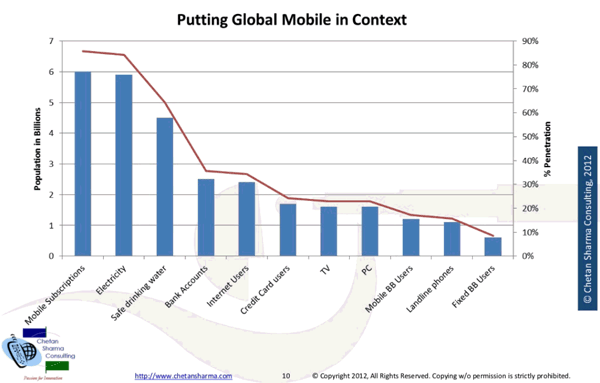 |
Of the approximate 326 million (2012) wireless subscriber connections in the United States (102% penetration); 89% are capable of accessing the web. There were over 318 cell phones sold in the U.S. per minute last year. To put that into context, there are approximately 7.5 babies born in the U.S. per minute.
With more than 50% of new phones sold in developed countries being smart phones, consumers are now ready to use their mobile phone for much more than simple communications - much more than voice calls, text or to surf the internet. They are ready to use their mobile phone in their practical daily life. They look at the phone to make their daily life easier. And what you do in your daily life is shop, buy and pay.
The revenue numbers hold promise as well. While online commerce is approximately 5% of retail sales, mobile is expected to get there in a fraction of the time.
Aside from the iPhone phenomenon, data connections for phones have been getting faster. As the industry moves toward fourth-generation (4G) networks that carry both voice and high-speed data, marketers are now being presented with real opportunities to reach customers, particularly the young and socially connected. How the landscape will shape is anybody's guess. The only thing that is fairly certain is that mobile as we know it will change drastically in the next 3-5 years.
While the ecosystem is set, that does not mean there will not be up hill struggles. Like Internet security, mobile security is not something that Marketers should be blind to. A study of cell phone owners by Harris Interactive for Billing Revolution found that 26% of cell phone owners feel that mobile shopping is "completely safe," and 45% think that it is "somewhat safe." WIth that said, 46% said that they would be willing to shop using their cell phone even if safety was not an issue. Attitudes vary based on age and sex as you'd expect. 59% of the 18-34 crowed felt that mobile shopping is somewhat safe, versus 34% of adults over 55. Half of men found the concept of cell phone shopping somewhat safe versus 39% of women.
Opportunities
Texting is as strong as ever. Look no further than American Idol. The winner of Season 6 received 74 million votes with 609 million votes cast over the course of the TV season for various candidates. That is more people than voted in the last U.S. election.
We are seeing new engagement models develop. Shazam allows radio listeners to acoustically identify songs via their iPhones and Blackberry's - allowing users to download the song or ringtone. There are QR codes (see CRMTrends' QR code to the right), location based services (shopkick), online price comparison (ShopSavvy), deep discount (Groupon), social media, tablets and immediate gratification (iTunes) offerings. In the UK, SatLav allows mobile users to send a text message with the word 'toilet' to 80097, and a satellite pinpoints their location. The satellite picks up the mobile phone's signal and uses it to find the location of the nearest phone tower. The database then automatically finds a toilet that matches the postal code of that phone tower - charging users 25 pence for each text. |
Broadway Marketplace, a small grocer in Massachusetts replaced its card-based loyalty program with one that uses mobile phones to identify the shopper.
Location-based services such as Loopt are social networking tools that allow users to announce their whereabouts and invite friends to join them.
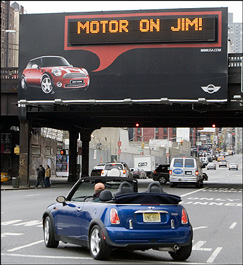
Mini USA introduced RFID-enabled billboards that "talk" to Mini motorists. Mini drivers in select US cities can utilize RFID key fobs to initiate personalized messages on billboards containing LED displays.
While mobile marketing is going mainstream, global mobile commerce, or m-commerce, is expected to grow steadily to an estimated US$630 billion industry by 2014 - mobile entertainment - ringtones, games, iTV, wallpaper, gambling etc - will continue to be the largest application for buying and selling via the mobile phone. Having taken root in Asia, m-commerce will continue its spread westward and once all of the players have agreed upon the rules, the m-commerce channel will be key to marketers.
M-commerce is already widespread in Asia and in some emerging economies, where users primarily connect to the Internet via cell phone, and telecom companies with monopolies make it easier to create nationwide infrastructures. The footprint of m-commerce becomes less visible as it moves west. Even before the universal adoption of m-commerce, mobile media buying is quickly becoming a new marketing channel where marketers can use context, time, location and interest when targeting consumers. For example, timed messages would allow a movie studio to send announcements about a new movie on Friday afternoon when people are making weekend plans. Interactive communication could provide customers with real time rewards or instantaneous promotions. One company, Ipsh.net, is a pioneer in the area of mobile marketing. Ipsh sends text messages to thousands of opt-in cell-phone users in the U.S. about the latest music, store discounts or movie updates. Warner Bros. launched such a campaign in advance of pop singer Madonna's latest album. Users gave their number and that of a friend and received a text message about the album. With the push of a button, they dialed in to receive a sound clip. The potential of this type of marketing is not lost on advertisers. Universal Records used text messaging to increase airplay for hip-hop artist Nelly's video. Shoemaker Reebok launched a marketing campaign that mixed clues, teasers, tips and testimony for its "WhoDunit?" campaign. For the Nelly campaign (which included Nelly's voice message), it resulted in 67.8% of users receiving the text message, dialing in to listen to Nelly's message. Then, more than half of those fans called BET to vote for his video. Reebok's campaign resulted in a 41% response rate. From a pure mCRM perspective in the B2C world, Starbucks and retailers as a whole, have the opportunity to implement the smartest application to date with in store high speed wireless Internet access through Wi-Fi hot spots. Though this is not a mobile phone based system, companies such as Starbucks, McDonalds and Borders in the US have an enviable and unique opportunity to communicate with its customers in store. Starbucks can become the gateway to the Internet by launching customers from a store specific Starbucks home page - which presents incredible opportunities for CRM - limited only by imagination. In fact Wi-Fi has become so popular that Zagat Survey, which rates restaurants in various cities, now offers a guide to Wi-Fi hotspots. Interestingly enough, while we've been touting this Wi-Fi opportunity for years - many years later, on March 16th 2006, two patents were published by the US Patent & Trademark office, granting Google:
|
Why does it take Google to figure out the obvious?
For the most part, the next five years will be about continuing to build the infrastructure that will allow for wireless access. While Shannon's Law cannot be undone (He said that English text is not compressible to fewer than about 1.5 binary digit per English letter, no matter how complex and clever the encoder), capacity will be constrained to the extent that new spectrums are released to the public.
Much of the online and mobile changes we are witnessing are being driven by the younger generation (Gen Y) - think Twitter, Facebook, FourSquare. This demographic is also the most mobile savvy. On Facebook alone, there are more than 250 million active mobile users. 1MM users commented on their friends’ status changes on mobile within the first 24 hours of this feature’s launch. These mobile users are twice as active as non users. This is a testament to the power of mobile and the engagement of this rising population. This is clearly an opportunity.
Mobile Marketing Best Practices
In years past, it was all about about creating destinations on the web. Now, the consumer is the destination. With smartphone adoption projected to grow to 68% by 2015 (Javelin), and with a projected 1/3 of US online consumers owning a tablet by 2015 (Forrester), we are well on our way to a point where mobile will be the primary digital means to connect to our new and existing customers. This increasing mobile adoption heightens the need for active engagement of ones customers in the mobile space, today.
Today, the mobile phone and tablet controls the television, stereo etc. One cannot escape the importance of these handheld devices. In treading into the mobile realm, it is critical not to have your mobile strategy dictated by technology. Answering some step-by-step questions will help develop a successful mobile engagement strategy:
- Who is your audience?
- What is your goal?
- What outcome do you expect?
Many mobile strategies go astray as companies do not fully understand how their customers use their mobile devices - instead adopting tactics merely because they want to be first, because their competitors are active in the space or because it is trendy, versus choosing a strategy and tactics that support your business goal of locking customer relationships.
This is not a case of "build it and they will come." Customers need and expect value, more so than at any other time in the past. They also expect real-time news/updates and personalization. As such, any mobile applications developed should, at a minimum, address these consumer expectations.
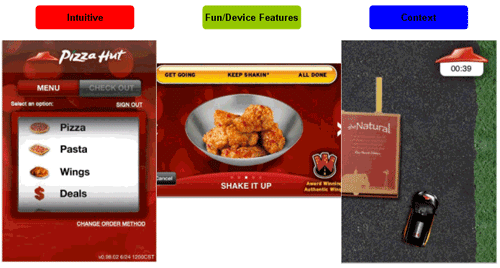
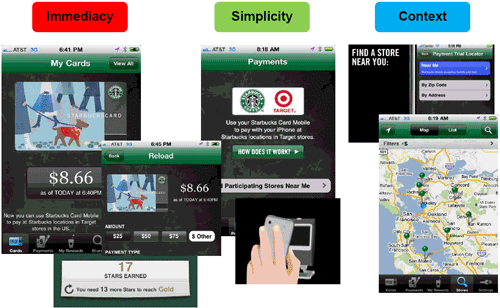
Mobile marketing appears to be following the evolutionary steps that we went through with the internet. Everyone is throwing up mobile apps but few are doing it well. With that said, mobile brings a new component that we didn’t have with the internet. We are now treading into an individual’s personal space. We need to be cognizant of that and, given the nature of mobile, solve problems for individuals on the go versus re-creating the desktop experience – the latter of which, unfortunately, many are doing. Even for a powerful brand, you need a compelling value proposition that is intuitive, hopefully fun, and leverages the device’s features.
The importance of giving consumers immediate, relevant and valuable messages will be critical. Start with understand what type of mobile device your population is using and develop your efforts based on those device capabilities: Feature Phone (12 digit keypad phones), QWERTY (keyboard but not a smartphone), smart phone (Android, Apple, Blackberry), tablet (iPad). If you have a lot of early generation phones, create a WAP site optimized for the mobile browser. If you have a lot of smart phone users, consider developing an App as App users typically consume more pages than web and WAP users. With that said, many smartphone users are divided as to whether they prefer Apps or the real site, so optimize for both and give your consumers the choice.
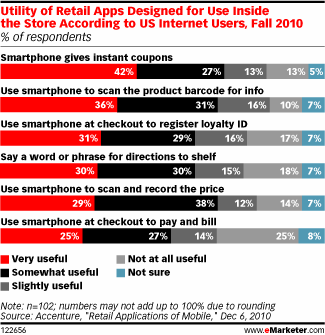
Focus content on the information your mobile users need on the go. Case in point, 39 percent of Cars.com mobile site visitors visit while on a dealer lot - 41 percent contact a seller using the phone number on the mobile site. Design your site and App for use outside the store and inside.
|
 |
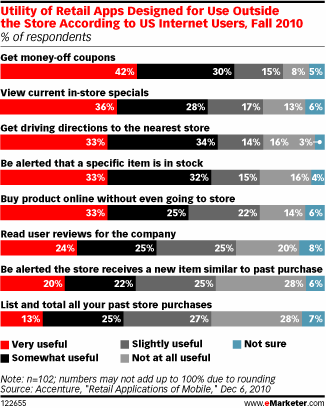
Get consumer feedback on site design, features and navigation. Consider allowing users to completely customize their mobile experience as personalized tools increase engagement.
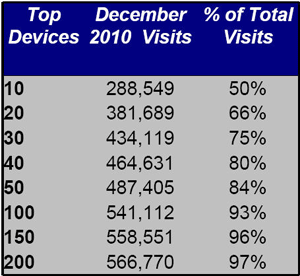
Recognize that there are more than just iPhones and Android phones in the market. Cars.com reports that over 1,100 devices visit their site on a monthly basis:
 |
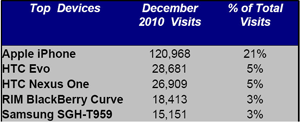
With that said, for Cars.com, touch screen smartphones are the top three devices:
 |
IDC's forecast of worldwide smartphone market growth: |
|
|
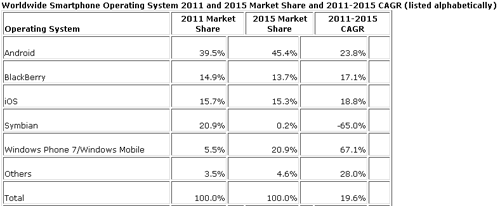
Note that Nokia's Symbian marketshare is being affected by Nokia's shift from Symbian to Windows Phone.
If we were to give a best practice award for doing it right in the mobile space, we'd award it to both Pizza Hut and Starbucks.
Pizza Hut:
|
Starbucks:
|
But as we have been discussing, mobile is not just the phone. iPads are changing the face of mobile as well.
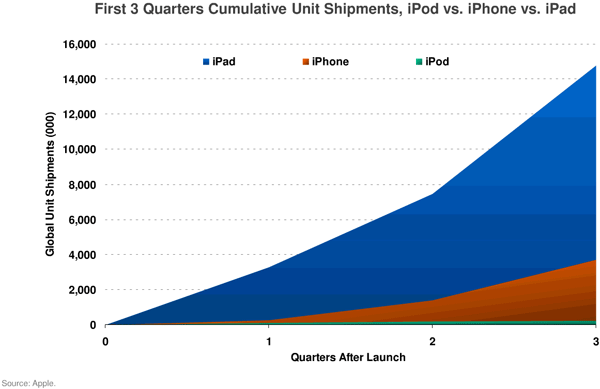 |
iPad traffic to wired sites continues to grow. For some companies, iPad users are accessing the wired site over other mobile products, which isn't bad as iPad users also spend more time with wired content. As such, consider developing an iPad App as clearly the needs of smartphone users and tablet users differ. That, and the fact that mobile app consumption (minutes of use) in the US actually exceeds web surfing (both mobile and PC).
Consider integrating consumer reviews/ratings on mobile, offering video content, point of sale tools, inventory alerts, consider GPS capabilities where appropriate e.g. AisleBuyer.
Evaluate your strategy for every customer touch point: pre-shop, in-store and post-shop (especially comments on consumer-review sites and apps). Immediacy is the key to mobile. At some point mobile will be the primary digital means to connect to your new and existing customers. Keep consumer needs and user experience at the forefront. Be prepared to adapt to a rapidly changing environment. Develop consistent measurement and operational processes;, be handset manufacturer, carrier and mobile browser agnostic. And integrate into every department within your company - your retail employees should know how to use your mobile App as well - if Pizza Hut can do it, so can your organization.
How consumers engage with brands has changed. Many people today are using three screens, e.g. sports. Consumers watch the game on TV, check scores on their laptop and check out what their friends think of the game via Facebook and Twitter on their smartphone.
For some companies, mobile traffic is expected to be north of 50% of all web traffic by the end of 2012. Executing mobile marketing best practices is more critical than ever.
Who's Who in the mCRM Technology Market
Crisp Media - mobile web site developer and site hoster
Geolocation: Foursquare, Gowalla, Kickball, MyTown, Loopt
Barcode Scanning: RedLaser, ShopSavvy, CheckPoints, ShopKick
Group Buying: Groupon, LivingSocial, BuyWithMe, SocialBuy and Groop Swoop
Inventory: Milo
Back End Technology:
Oracle/PeopleSoft
PeopleSoft teamed with Research in Motion (RIM) to offer PeopleSoft Enterprise Sales for BlackBerry. Sales reps can enter information once, and that data is stored simultaneously in the sales app and Outlook or IBM's Lotus Notes. When the device detects a wireless connection, it automatically syncs data with the core Sales Force Automation system.
Siebel
Siebel recently announced its partnership with wireless provider Good Technology to offer its hosted solution, CRM OnDemand . Wireless access is provided via Palm and PocketPC devices, and eventually, Symbian-powered handheld's and smart phones.
SAP
mySAP CRM offers wireless access to field reps through a variety of devices: laptops, PDAs, and other handheld's. Mobile workers have access to core sales CRM functionality, including sales forecasting, sales pipeline data analysis, task management, quote generation, and submitting sales orders.
Microsoft
Microsoft CRM Mobile is completely integrated with its CRM app, offering full-functionality from a Pocket PC or Pocket PC Phone Edition with Windows Mobile 2003 software.
IBM
IBM is partnering with Siebel to develop CRM solutions on its WebSphere platform. It has become a market leader in providing pre-packaged, industry-specific wireless solutions.
Sybase
iAnywhere, a subsidiary of Sybase, provides mobile middleware, databases, and device management for CRM applications, such as mobile ProspectSoft.
Salesforce.com
This hosted CRM solution offers a Wireless Edition that is free to its Enterprise Edition customers. Via RIM Blackberry, wireless PDAs, or a WAP-enabled mobile phone, mobile workers have a real-time connection to salesforce.com with no need to sync data.
Saleslogix for PocketPC
Saleslogix, from parent company Best Software, offers a full-featured CRM solution, which is available via PocketPC. This device gives sales reps the ability to view, add, and edit contacts and accounts; complete tickets; schedule meetings; and more.
Salesnet
Hosting both the CRM application and the data, Salesnet is sold by subscription in a range of editions, according to the size of the enterprise and the type of industry.
Click here for Books of Interest
|
Sites of Interest: Wireless Mobile Research Center - The latest wireless and mobile news, analysis and research links |
 |
Articles of Interest:
Mobile will be the next hub of social media
Top 10 Reasons Your Website Should Go Mobile
Sprint Delivers Mobile Coupons For Movie Theaters

In keeping with our site's mission to represent CRM best practices, we reiterate our call that should you come across content and links that, in your opinion, represent the best of the Internet, we strongly encourage you to pass them along so we can continue to keep our community abreast of the latest and best.